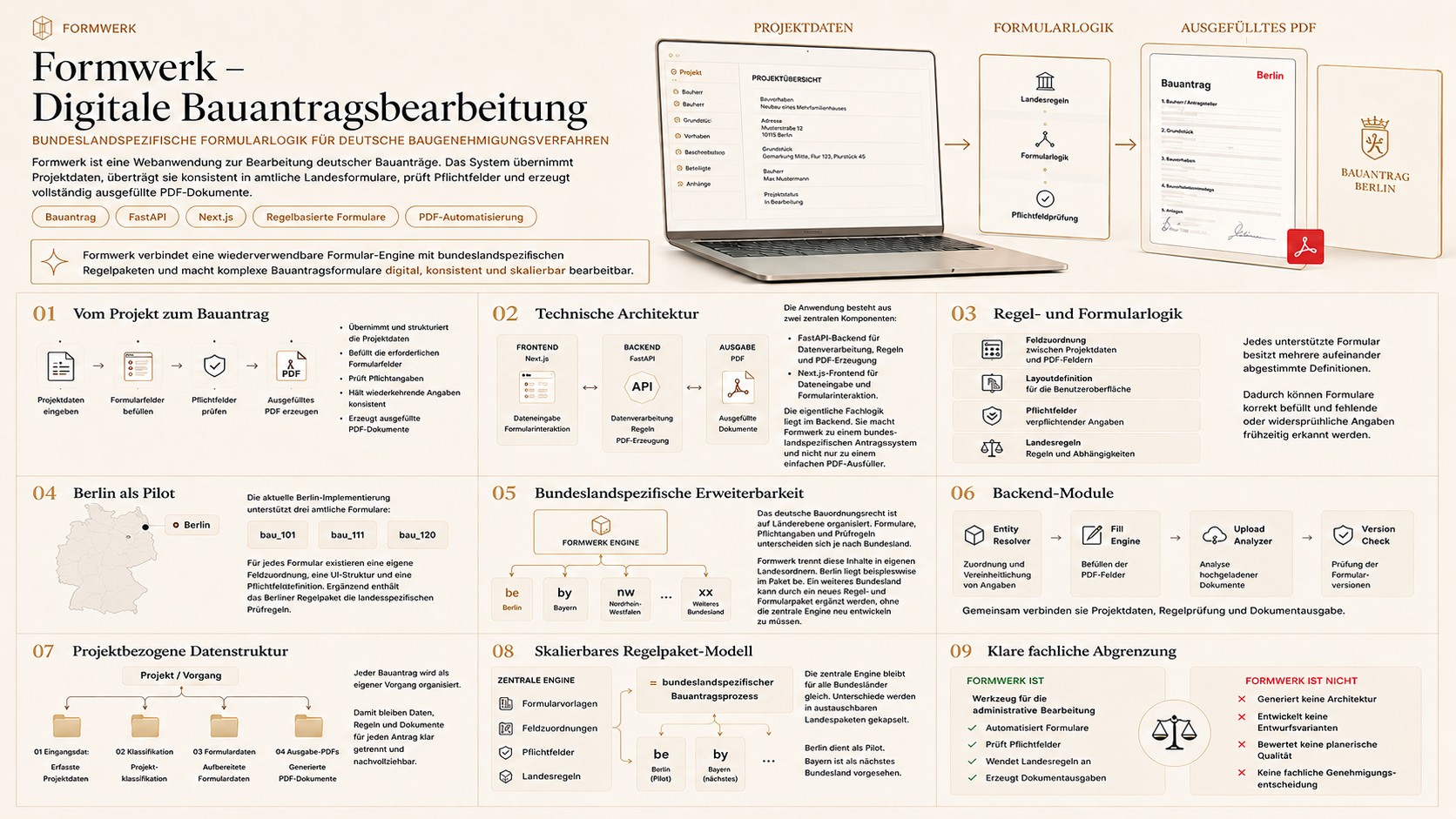
German building permit law is organised at state level. The forms, the mandatory fields and the checking rules differ from one Bundesland to the next, but the process underneath them is the same everywhere. Formwerk separates the two: one reusable engine and per-state rule packages that plug into it.
The problem
A Bauantrag — a German building permit application — is a stack of official forms in which the same project data is transcribed by hand, repeatedly, into different layouts. The same address, plot designation, client and building description reappear across a dozen documents. Every transcription is a chance to introduce an inconsistency, and an inconsistency between forms is a reason for the authority to return the application.
This is administrative work, not design work. It absorbs a disproportionate share of an architect's time and none of their judgement.
How the system works
Project data goes in once. The engine maps it to the fields of the official forms, checks mandatory entries and produces completed PDFs.
Architecture. A Next.js frontend for data entry and form interaction, a FastAPI backend for processing, rules and PDF generation. The domain logic lives in the backend — that is what makes Formwerk a state-aware application system rather than a PDF filler.
Rule and form logic. Each supported form carries several coordinated definitions: the field mapping between project data and form fields, the layout definition for the interface, the mandatory-field specification and the state rules with their dependencies. Together these ensure forms are filled correctly and that missing or contradictory entries surface early.
Backend modules. An entity resolver that unifies and reconciles entries, a fill engine that populates the PDF fields, an upload analyser for documents the user supplies and a version check for form revisions — official forms change, and an application built on a superseded version is rejected.
Berlin as pilot. Tested on sample data, not on a submitted application. The current implementation supports three official Berlin forms — bau_101, bau_111, bau_120. Each has its own field mapping, UI structure and mandatory-field definition; the Berlin package adds the state-specific checking rules on top.
State extensibility. The engine stays identical across states. A further Bundesland is added by writing a new rule and form package — Bayern is planned next — without touching the core.
Project data structure. Every application is organised as its own case: input data, classification, prepared form data and generated output PDFs kept separate and traceable.
My contribution
Sole author. I designed the engine/rule-package separation, wrote the Berlin rule package, built the backend modules and the frontend and specified the form field mappings against the official Berlin forms.
What Formwerk is
- A tool for the administrative part of the permit process
- Automates form completion
- Checks mandatory fields
- Applies state rules
- Produces document output
What Formwerk is not
- It does not generate architecture
- It does not develop design variants
- It does not assess planning quality
- It does not make any professional or regulatory approval decision
That distinction is the point of the project, not a disclaimer attached to it. The permit process contains a large amount of work that is genuinely mechanical and a much smaller amount that requires an architect's liability and judgement. Formwerk is deliberately confined to the first.