AI in architecture is often discussed through the image: a generated perspective, a transformed façade or a visual variation produced from a prompt.
That image is useful, but it represents only one moment in a much larger process. Architecture moves through briefing, concept design, coordination, documentation and construction—each stage producing information that must be interpreted, tested and carried forward.
This framework considers where AI can support that work without removing judgment, authorship or responsibility from the architect. It is a working model, not a software product or prediction of a fully automated practice.
01 / The architectural workflow
From brief to construction
Architectural projects are not a single act of design. They are a sequence of connected decisions, moving from brief to concept, design, coordination, documentation and construction.
At every stage, teams interpret constraints, test alternatives, exchange information and make decisions that affect the next stage. The opportunity for AI is therefore not limited to producing images. It lies in helping architects structure information, reveal relationships, test assumptions and reduce repetitive work.
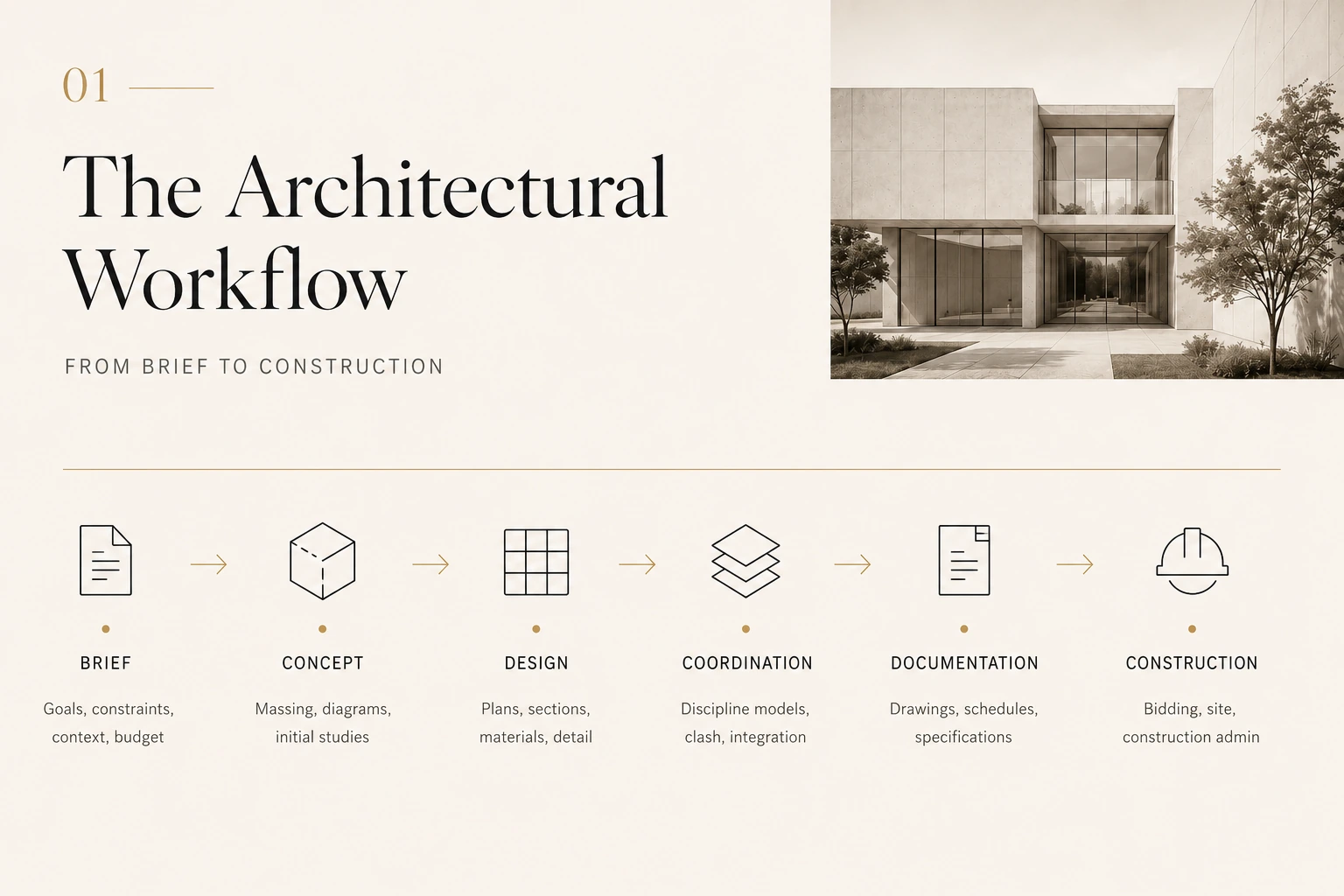
The workflow is deliberately simple. Real projects are iterative: decisions return to earlier stages, requirements change and new constraints emerge. AI should support that iteration rather than present a linear process as solved.
02 / An AI layer across the project lifecycle
Rather than treating AI as one application, it may be more useful to understand it as a supporting layer across the project lifecycle.
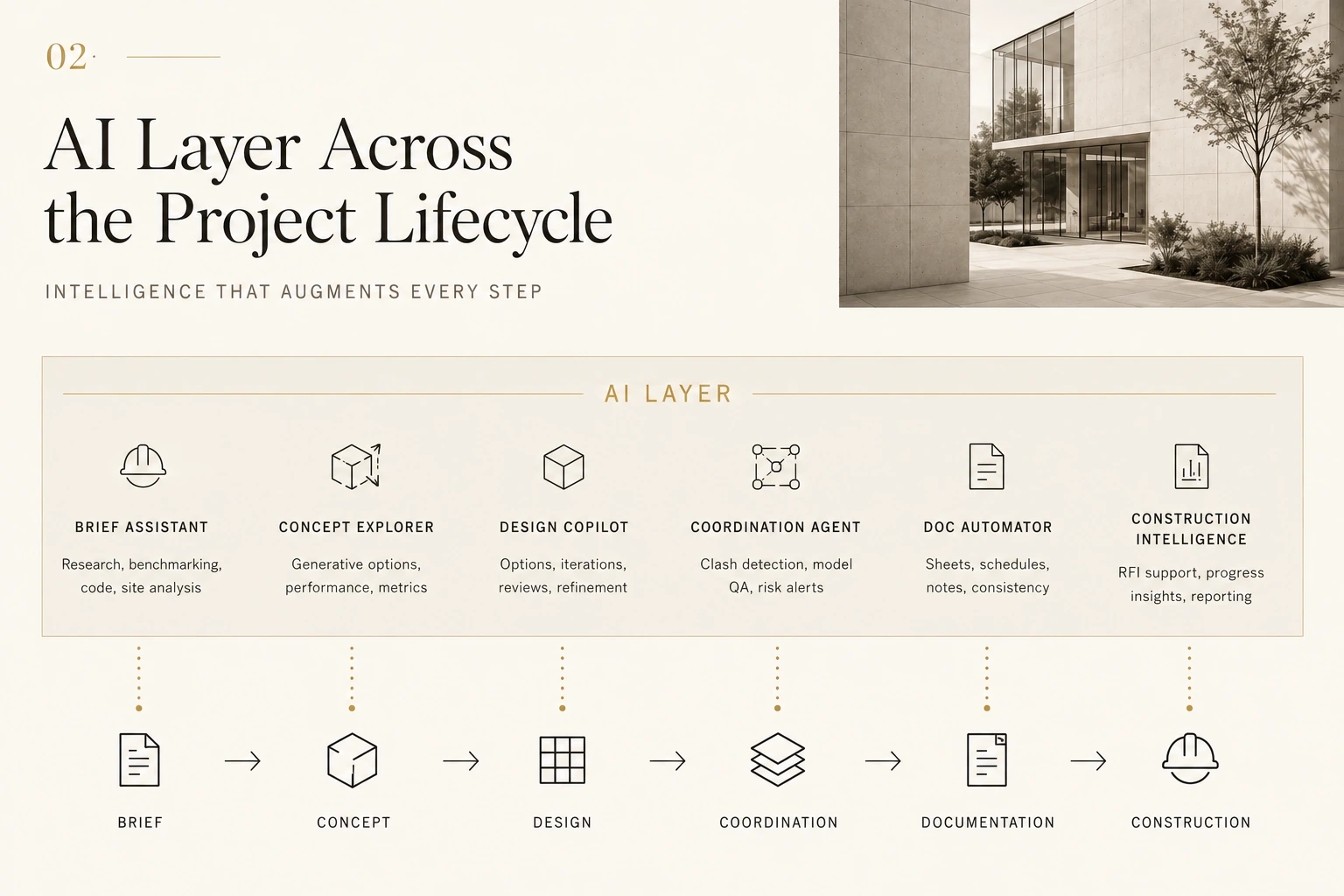
Intelligence that augments every step
The diagram proposes six areas of support: brief assistance, concept exploration, design critique, coordination, document automation and construction intelligence.
Each area has a different relationship to project information:
- Brief assistant — Structures requirements, constraints, context and relevant regulations.
- Concept explorer — Supports the comparison of alternatives against defined design criteria.
- Design copilot — Helps test options, relationships and performance during iterative design.
- Coordination agent — Supports information checks, integration, quality assurance and risk review.
- Document automator — Assists with repeated information across drawings, schedules, notes and forms.
- Construction intelligence — Supports the organisation and review of RFIs, progress information and site decisions.
These capabilities should not be understood as autonomous roles. Their usefulness depends on access to structured project information, clearly defined limits and review by the people responsible for the work.
A useful architectural system should make its inputs, assumptions and limits visible. It should help a team ask better questions, not hide uncertainty behind an answer.
03 / Evolving roles, intelligent teams
Architectural projects already depend on distributed expertise. A project architect, designer, BIM coordinator, sustainability consultant, structural engineer and construction manager each contribute different forms of knowledge.
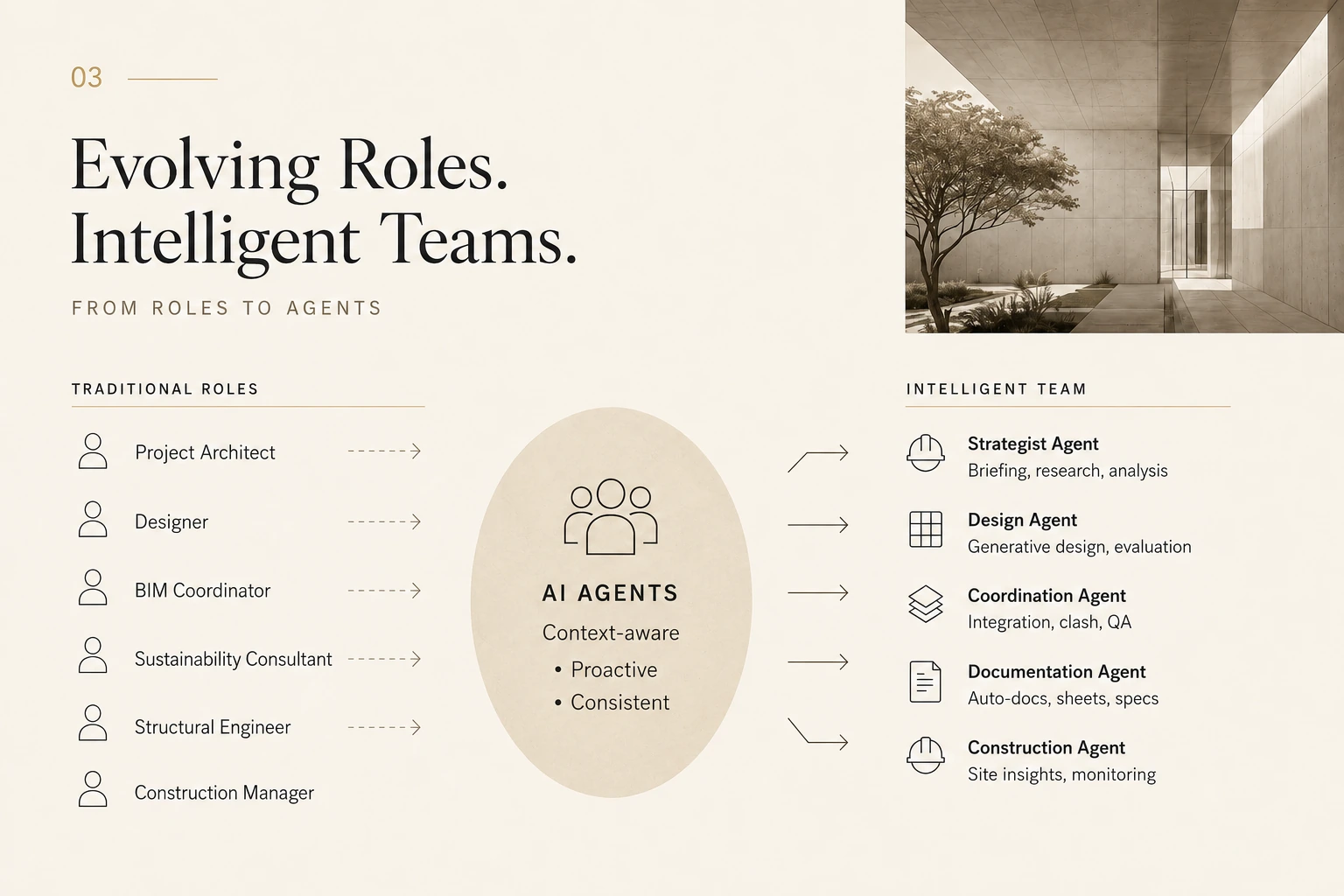
From roles to agents
AI does not remove this structure. It may add specialised forms of support around it.
A strategist agent might assist with briefing and research. A design agent might generate or assess controlled variations. A coordination agent might identify inconsistencies across project information. A documentation agent might support repeated tasks across schedules, forms and drawing sets.
These are not replacements for architects, consultants or project managers. They are context-aware assistants with defined tasks, limited permissions and clear review points.
The architect remains responsible for framing the problem, deciding which criteria matter, judging alternatives, coordinating expertise and accepting professional responsibility for the outcome. This is particularly important where decisions affect planning approval, safety, cost, accessibility or the contractual information issued to others.
04 / A people-centred operating model
Our north star
Use artificial intelligence to expand creative capacity, improve decision quality and deliver better buildings—together.
People-centred
Augment expertise; never replace it.
Data-informed
Better inputs create better decisions.
Iterative by design
Test, learn and refine continuously.
Responsible AI
Keep systems transparent, ethical and accountable.
The open question
Image generation is the most visible use of AI in architecture because it is immediate and easy to demonstrate. The harder opportunity lies in the less visible work of interpreting requirements, maintaining consistency, checking rules, coordinating information and preparing decisions that others must rely on.
That work is repetitive, but it is not mindless. It contains architectural judgment, regulatory knowledge, project context and professional responsibility.
AI becomes useful in architecture when it moves beyond producing images and begins to support the chain of decisions that makes a building possible.